
Euglena Presents Microalgae-Based Resource-Recycling Food Production Systems at CHIBADAI International Workshop on Space Agriculture and Horticulture 2026
About the Workshop
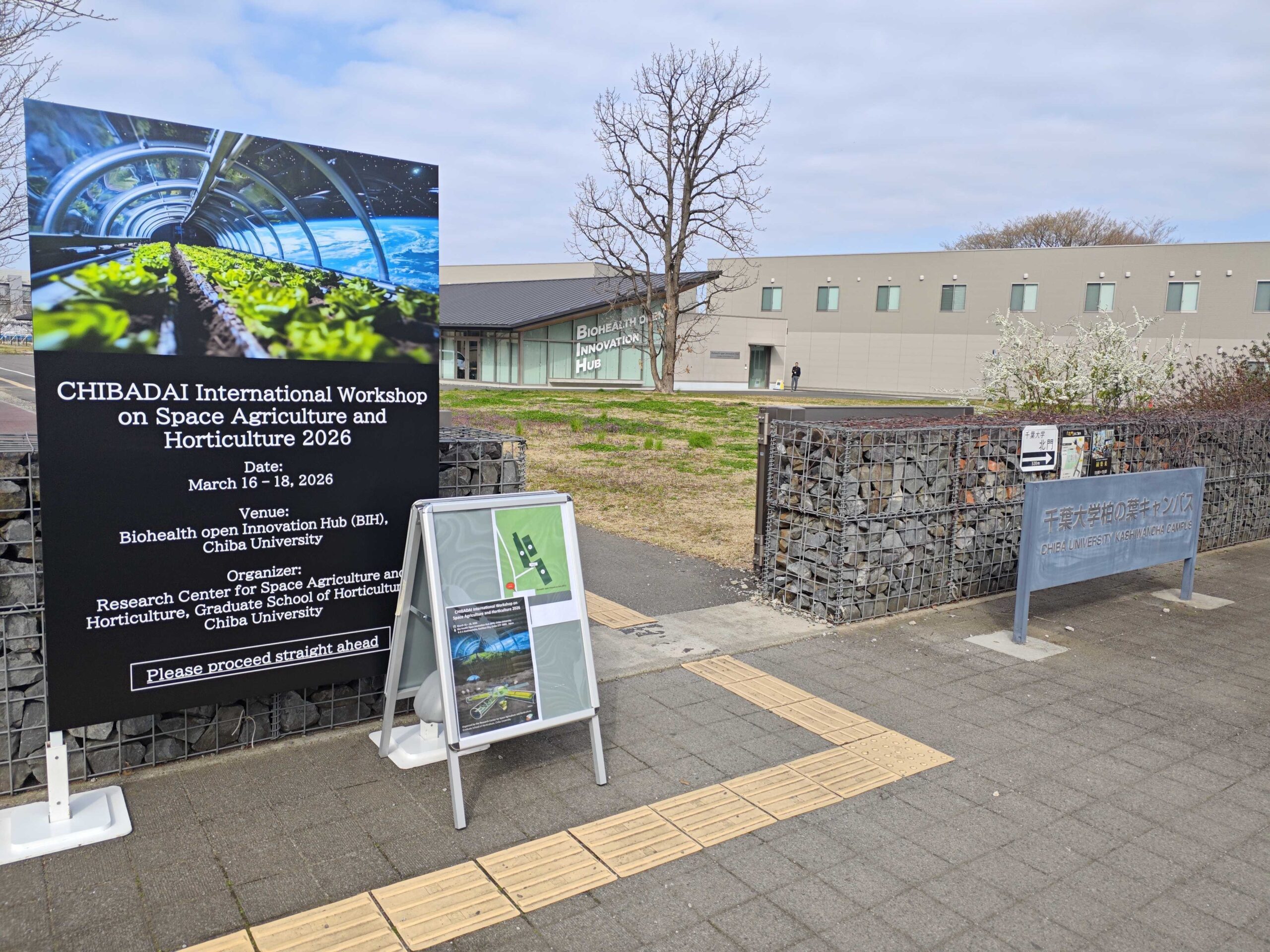
The 2nd CHIBADAI International Workshop on Space Agriculture and Horticulture 2026 was held from March 16 to 18 at Chiba University’s Biohealth Open Innovation Hub (BIH) on the Kashiwanoha Campus in Kashiwa, Chiba Prefecture. Organized by the Research Center for Space Agriculture and Horticulture, Graduate School of Horticulture, Chiba University, the workshop brought together leading researchers and experts from space agencies, universities, and industry worldwide to discuss the latest advances and future directions in space agriculture and horticulture.
The program featured six thematic sessions spanning topics from the strategic vision of space agriculture and lunar farming, to plant physiology under microgravity, and the use of algae, moss, and aquatic plants for space-based food production. Speakers from NASA, ESA, JAXA, DLR, and leading academic institutions presented on areas including circular life support systems, plant environmental engineering for lunar farms, resource regeneration systems, and Japan’s spaceflight experiments with plants. A poster session and mixer event on March 17 further facilitated interdisciplinary exchange among participants.
The workshop’s first day (March 16) was dedicated to facility tours and meetings for related parties, including an introduction to the Science Council of Japan’s Future Academic Promotion Vision and JAXA’s “Academic Hub” concept for sustainable lunar societies. The main workshop sessions ran on March 17 and 18, culminating in a comprehensive discussion on future collaboration.
Session V: Algae, Moss and Duckweed for Space
Dr. Kengo Suzuki of Euglena Co., Ltd. delivered a 25-minute presentation during Session V, entitled “Algae, Moss and Duckweed for Space,” which was held on the morning of March 18. Chaired by Prof. Tomomichi Fujita of Hokkaido University, this session explored the potential of non-vascular organisms for space agriculture. Other speakers in the session included Prof. Jenny Mortimer (University of Adelaide / P4S) on plant cell wall responses to altered gravity, Dr. Tatpong Tulyananda (Mahidol University) on watermeal for space agriculture, and Prof. Kimitsune Ishizaki (Kobe University) on liverworts and synthetic biology for space food solutions.
Dr. Suzuki’s Presentation: Key Highlights
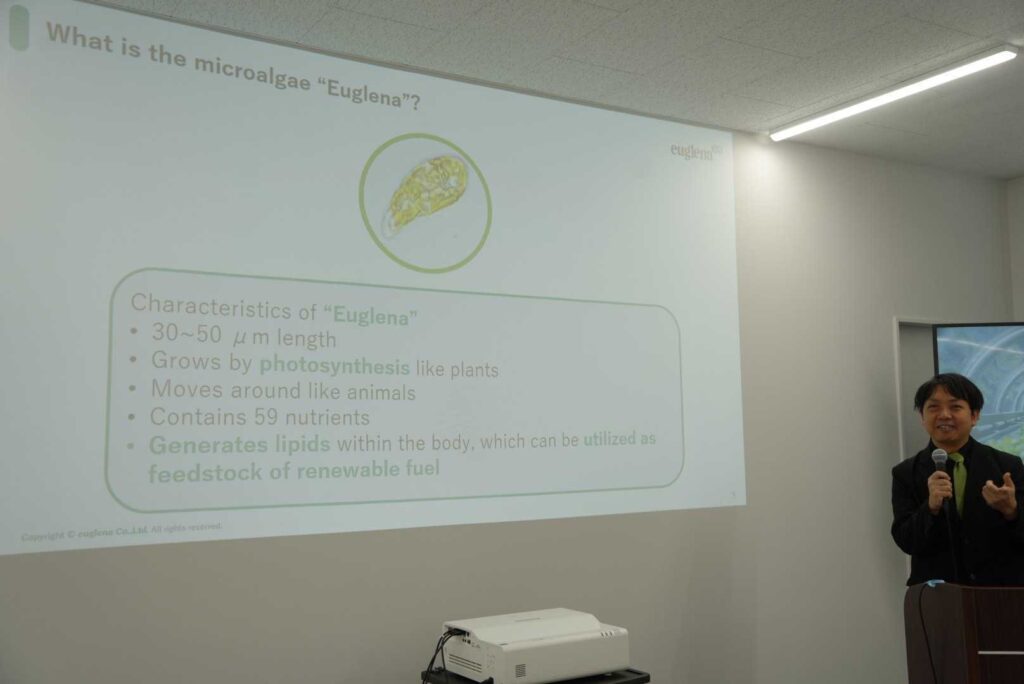
Dr. Suzuki’s presentation, titled “Construction of Resource-Recycling Food Production Systems Using Microalgae in Closed Space Environments,” outlined ongoing efforts at Euglena Co., Ltd. and the RIKEN Baton Zone Program to develop microalgae-based bioregenerative life support systems for future lunar and Martian habitation.
The Challenge: Closed-Loop Life Support
Long-duration human habitation on the Moon and Mars will require closed-loop life support systems capable of recycling resources and producing food in situ. Microalgae—with their rapid growth, high photosynthetic efficiency, and exceptional nutritional versatility—are among the most promising organisms for the biological core of such systems. The presentation focused on three key species: Euglena gracilis, Chlorella, and Spirulina.
SPACE FOODSPHERE and the Stardust Program
Dr. Suzuki described the SPACE FOODSPHERE program, a multi-stakeholder initiative in Japan developing integrated food supply systems for future extraterrestrial bases. Within this framework, the Japanese government-supported Stardust Program aims to establish resource-recycling food supply technologies suitable for space settlements. A central concept is the use of microalgae to convert waste streams—including CO2 from crew respiration and nitrogen compounds from urine—into edible biomass while simultaneously regenerating oxygen.
Advantages of Euglena gracilis for Space
Euglena gracilis was highlighted as offering particular advantages for space applications. It utilizes ammonium nitrogen directly without requiring enzymatic conversion, grows under acidic conditions that inherently reduce microbial contamination risk, produces 59 essential nutrients including vitamin D, and is amenable to genome editing for targeted trait optimization. These properties make it an ideal candidate for compact, reliable bioregenerative systems in the challenging conditions of space habitats.
Integrated Systems and Satellite Experiments
Current research integrates microalgae cultivation with higher plant growth systems and cultured meat production technologies, developed in collaboration with academic and industrial partners, to achieve a diversified, closed-loop food supply chain.
Significance and Outlook
Dr. Suzuki’s participation in this workshop underscores Euglena Co., Ltd.’s expanding role at the forefront of agriculture research. Following presentations at the 69th Japan Society for Aeronautical and Space Sciences Joint Conference in November 2025 and the ASCEND 2023 Conference, this workshop provided an important platform to share Euglena’s integrated approach to resource-recycling food production with the international space agriculture community.
The CHIBADAI Workshop, with its participation from NASA, ESA, JAXA, DLR, and leading universities across Asia-Pacific, Europe, and North America, represents one of the most comprehensive academic gatherings on space agriculture globally. Euglena’s contribution to Session V on algae and non-vascular organisms for space highlighted the company’s unique position at the intersection of commercial microalgae biotechnology and space life support research.
As we look ahead, Euglena Co., Ltd. remains committed to advancing microalgae-based bioregenerative systems that serve both humanity’s aspirations for deep space exploration and the urgent need for sustainable food production on Earth. The knowledge exchange and collaborative networks fostered at this workshop will be instrumental in driving the next phase of this research forward.
Event Information
Workshop: CHIBADAI International Workshop on Space Agriculture and Horticulture 2026
Dates: March 16–18, 2026
Venue: Biohealth Open Innovation Hub (BIH), Kashiwanoha Campus, Chiba University
Organizer: Research Center for Space Agriculture and Horticulture, Graduate School of Horticulture, Chiba University